
Why it exists
Choosing where to open is mostly done on instinct, a drive around, and whatever the letting agent says. The data that would answer it properly does exist, scattered across census tables, deprivation indices, business registers and mapping databases that nobody has time to join up.
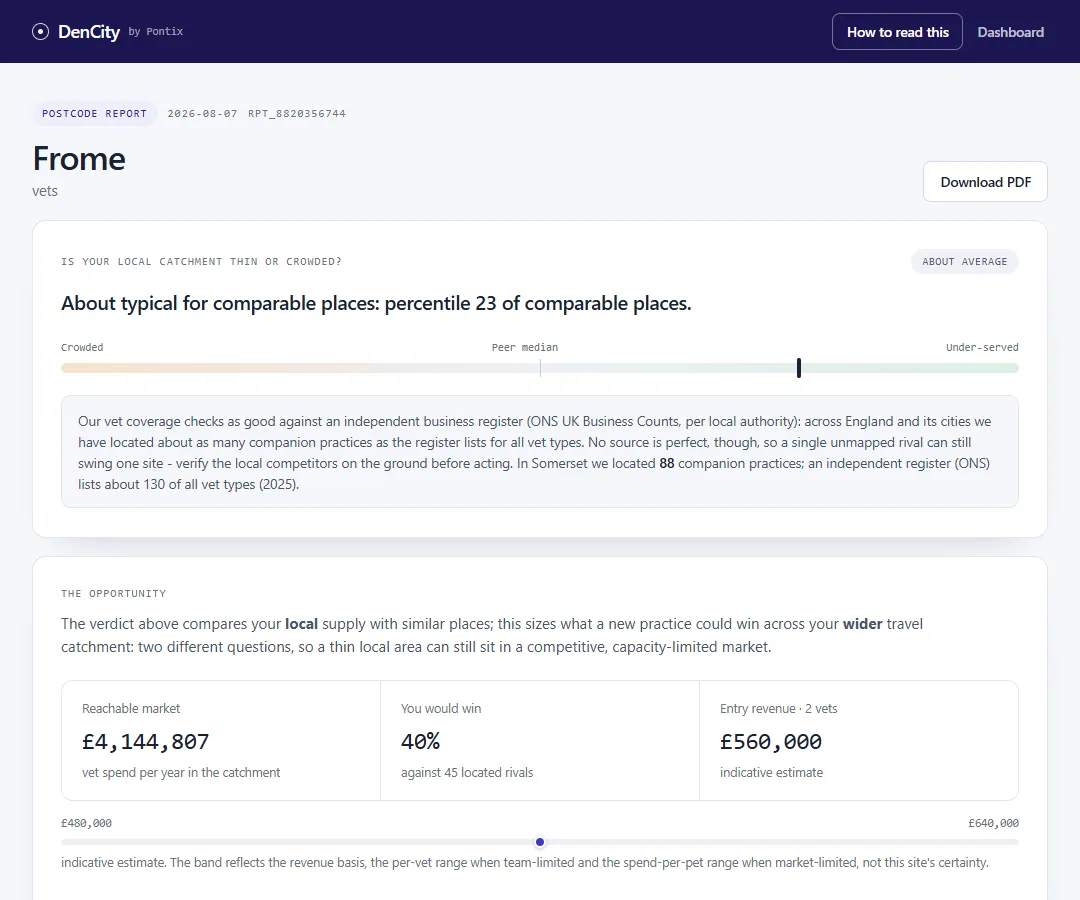
DenCity joins them up, and answers two questions that are easy to confuse. Is the catchment around this site thinly or thickly served compared with places genuinely like it? And separately, what could a new practice realistically bill here? A thin local area can still sit in a competitive, capacity-limited market, so the two are reported side by side and never blended into a single score.
It is a screening tool, not a predictor. It tells you which sites are worth investigating and which are not worth the drive. It will never tell you that opening somewhere is going to work.
What makes it different
The comparison is against a real peer group, not the national average. Places are bucketed by settlement class and income band, so a market town is judged against market towns of similar affluence rather than against inner London.
No input is counted twice, and where one has been deliberately excluded we say why. Income picks the peer group for the verdict, and separately sets spend per pet for the money; how many pets there are comes from the local housing mix instead. Each factor does one job. Double-counting is the easiest way to make a model look confident and be wrong.
Revenue is the lesser of what a team that size can produce and what the site would win against its rivals, and DenCity tells you which of the two is binding. That is the difference between a market you cannot reach and one you cannot staff, and it changes what you do next.
It admits what it cannot see. Coverage is checked against an independent business register rather than asserted, and where the map may be missing a rival, the report says so instead of dressing a gap in the data up as an empty market.
What you actually get
Two reports, depending on how far along you are
A postcode report tests a site you already have in mind. A region report ranks the strongest openings anywhere within 75 km of your search, so the best candidate can be somewhere you had not thought of.
A verdict with the working attached
Under-served, about typical, or crowded, always alongside the percentile it sits at within its peer group and the components that produced it.
Compared with like, not with everywhere
Fifteen region types, built from three settlement classes and five income bands, so the benchmark is places genuinely similar to the one you are looking at.
Sized in pounds, as a range
Reachable market, the share winnable against located rivals, and an indicative entry revenue. Always a range, because it sizes an opportunity rather than forecasting one.
Coverage reported, not claimed
The located competitor set is benchmarked against an independent business register, per local authority, and the result is printed on the report. A single unmapped rival can still swing one site, and it says so.
Vets in England, to begin with
The engine is sector-agnostic, but the reference dataset and classification rules are built for veterinary practices first. Other sectors follow once that pillar is proven.